

Where to configure
In the Portal, configuration appears in these places:- Application:
/application/:applicationId→ Configuration - Intent Group:
/intent-group/:intentGroupId→ Configuration - Intent (ApplicationAction):
/application/:applicationId/intent/:actionId→ Configuration - Test Run: the Test Run wizard includes a configuration step used for that run
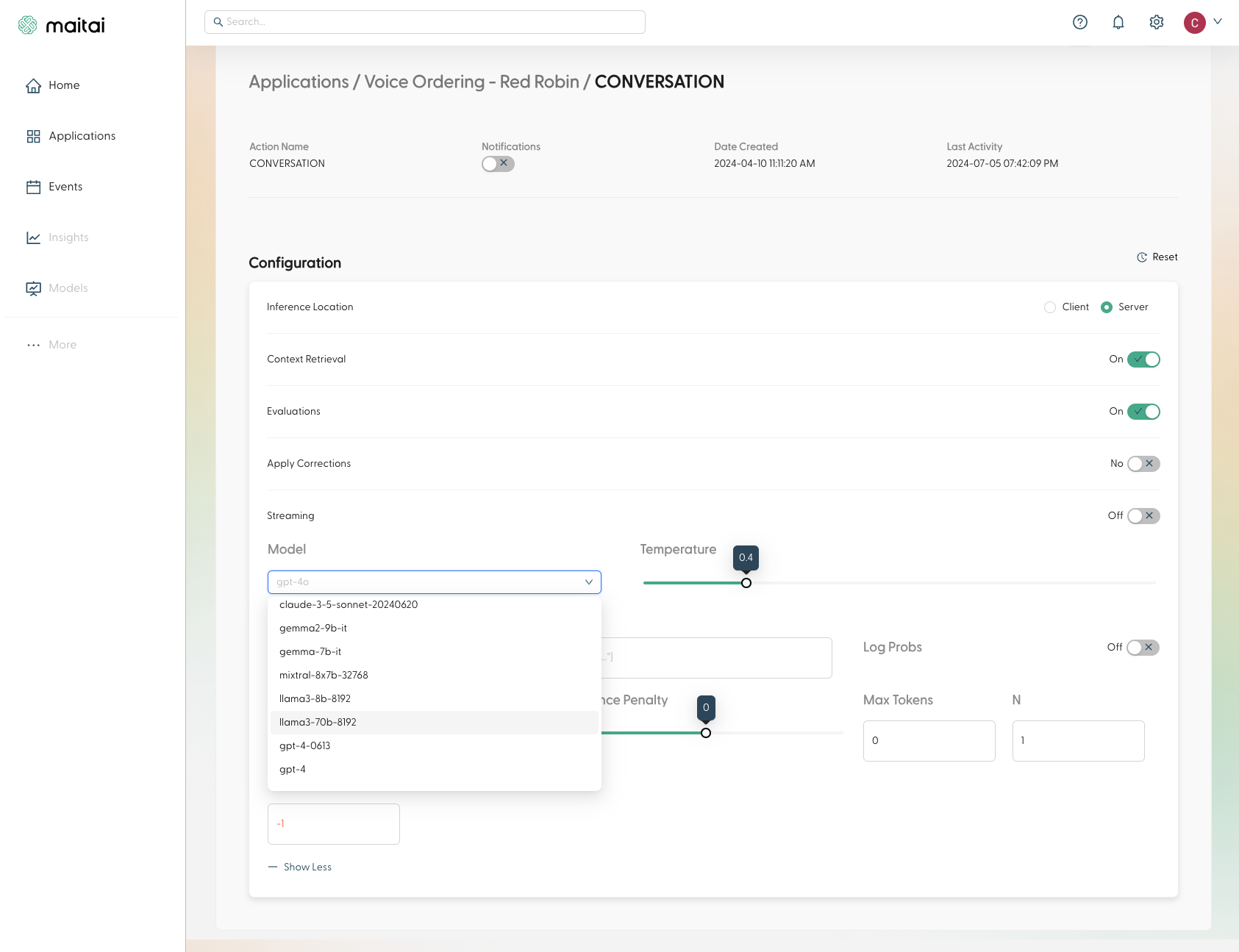
Common patterns
Enable evaluations + corrections
- Turn on Evaluations
- Optionally turn on Apply Corrections
- This toggle is only available when evaluations are enabled.
- Enabling corrections unlocks Safe Mode.
Add a secondary model + fallback behavior
- Select a Secondary Model
- Choose a Fallback Strategy
- Optionally set a Fallback Timeout (only appears for timeout strategy)
Make output more deterministic
- Lower Temperature
- Use a Stop Sequence
- Set Max Tokens
Parameters available in the Portal Configuration panel
Controls where inference is executed.
Controls the model’s reasoning depth when supported by the selected model.
Enables Sentinel evaluation for requests at this scope.
Enables automatic correction behavior when evaluations identify faults.
Safe mode prioritizes accuracy over latency. Only available when Apply Corrections is enabled.
Primary AI model to be used for inference. Models are grouped by provider and sorted alphabetically, with Maitai models (recommended) appearing first.
Optional fallback model to use if the primary model is not available or has degraded performance.
Strategy to use when falling back to secondary model. Options:
reactive: Falls back on primary model failure- If a timeout is specified, it will initiate the fallback request after the timeout period
timeout: Falls back after specified timeout periodfirst_response: Uses whichever model responds first- If a timeout is specified, it will only use the fallback model after the timeout period
Timeout in seconds before falling back to secondary model. Only applicable when using the “timeout” fallback strategy.
Controls randomness in the model’s output. Range 0-2, where:
- Lower values (e.g., 0): More deterministic output
- Higher values (e.g., 2): More random output
Sequences where the API will stop generating further tokens.
Include the log probabilities of the output tokens.
How many completions to generate for each prompt.
The maximum number of tokens to generate in the completion.
Range -2 to 2. Increases the model’s likelihood to talk about new topics.
Range -2 to 2. Decreases the model’s likelihood to repeat the same line verbatim.